Granular vs. Liquid Fertilizers: How Turf Professionals Choose the Right Tool
Choosing between granular and liquid fertilizers is a common decision point for turf professionals managing golf courses, sports fields, and commercial landscapes. While turfgrass ultimately absorbs nutrients in the same ionic form regardless of delivery method, the performance, efficiency, and practicality of granular versus liquid fertilizers vary significantly. Understanding these differences allows turf managers to design nutrient programs that align with seasonal goals, labor resources, and turf performance expectations.
Granular Fertilizers: Foundation of Long-Term Turf Nutrition

Granular fertilizers are dry, pelletized products typically applied with broadcast or drop spreaders. Their greatest advantage lies in controlled and slow-release nutrient delivery, which supports consistent growth over extended periods. For large acreage turf operations, granular fertilizers are often more cost-effective and logistically efficient. Many formulations incorporate slow-release nitrogen technologies that reduce surge growth and minimize nutrient loss. This makes granular products well suited for base fertility programs that prioritize steady color, density, and root development.
However, granular fertilizers rely on moisture to move nutrients into the soil profile. As a result, turf response may be slower, especially during dry conditions. Precision during application is also critical, as uneven spread patterns can result in streaking or inconsistent turf quality.
Liquid Fertilizers: Precision and Rapid Turf Response
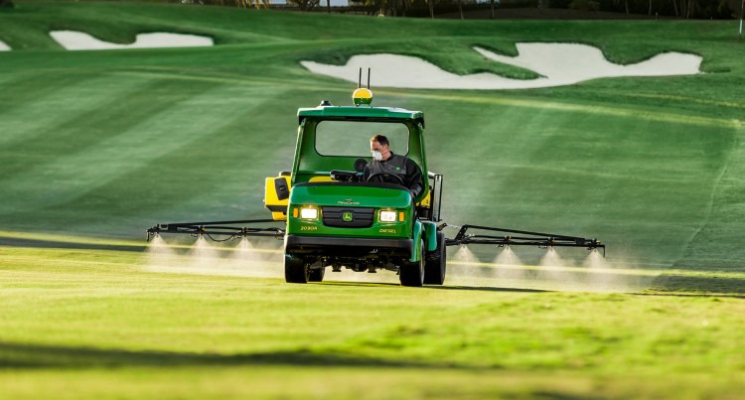
Liquid fertilizers deliver nutrients in a dissolved form, allowing for fast uptake and visible turf response. This makes them an excellent option for correcting nutrient deficiencies, enhancing color prior to play or events, or supporting turf during periods of stress. Liquids offer exceptional application uniformity and flexibility. They can be applied at low rates, targeted to specific areas, and easily integrated into spray programs alongside plant protection products or biostimulants. For turf professionals managing high-performance surfaces, liquid fertilizers provide fine-tuned control over nutrient inputs. The tradeoff is frequency. Because liquid fertilizers typically provide short-term feeding, they require more frequent applications and can carry a higher cost per acre over time. Proper spray equipment and calibration are also essential to achieve optimal results.
Integrating Granular and Liquid Fertilizers into a Turf Program
Rather than choosing one exclusively, many turf professionals achieve the best results by using granular and liquid fertilizers together. Granular products form the backbone of a season-long fertility plan, while liquid applications supplement nutrition when rapid response or precision is required.
By understanding how each fertilizer form performs, turf managers can build balanced nutrient programs that support healthy turf, efficient operations, and consistent playing conditions throughout the season.