Why Thick Turf Struggles Under Dense Tree Canopies
Why Thick Turf Struggles Under Dense Tree Canopies
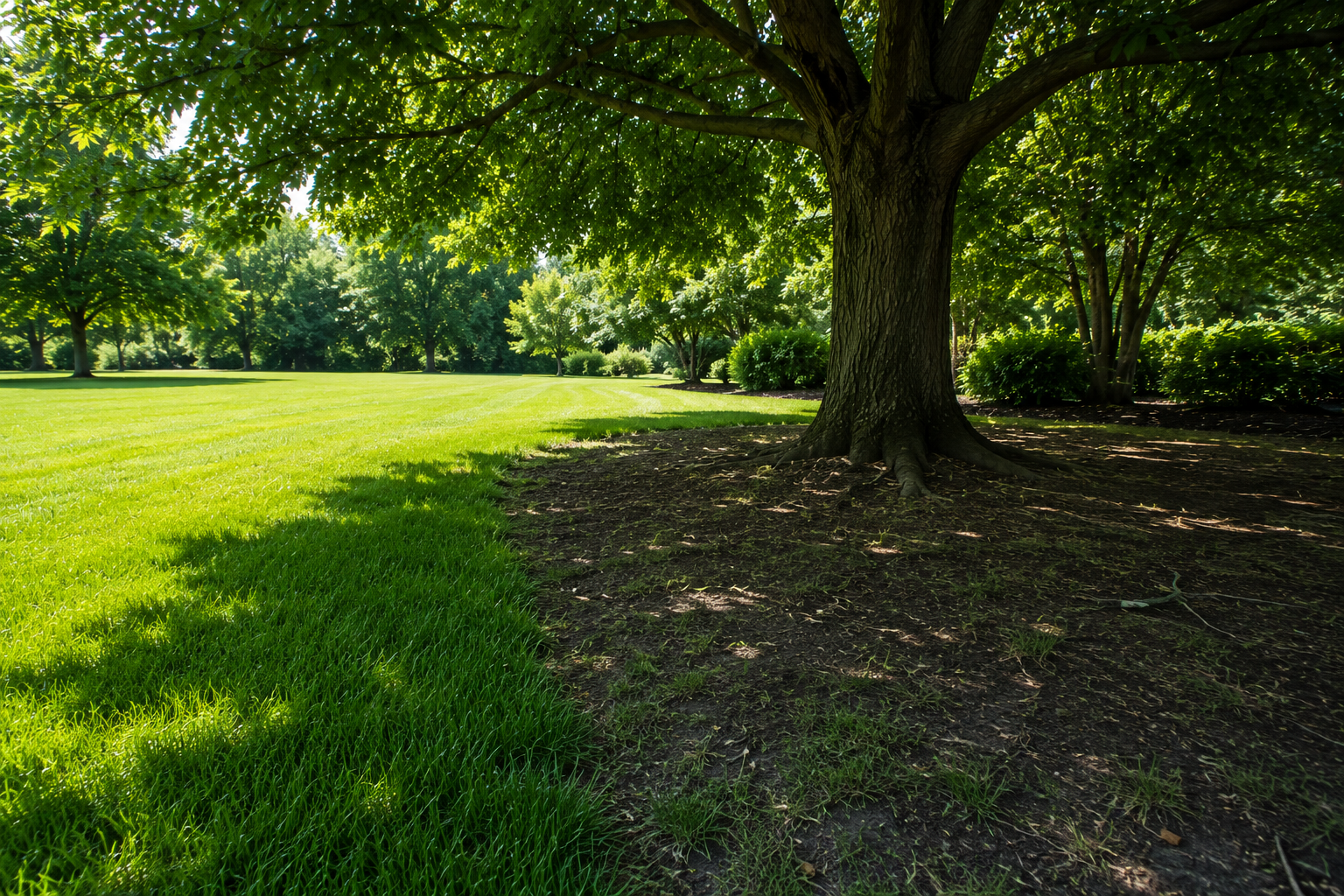
Few landscape challenges are more common than trying to establish and maintain dense turf beneath mature trees. While many people assume the problem is simply "not enough sunlight," the reality is more complex. Turf growing under a dense canopy experiences changes in both the amount and quality of light, triggering physiological responses that make it difficult for grass to develop the thick, resilient stand most property owners expect.
Understanding why this happens can help landscape professionals set realistic expectations and make better management decisions.
It's Not Just Less Light
Tree canopies reduce the total amount of sunlight reaching the turf, but they also change the type of light that reaches the grass.
Leaves absorb much of the red light used during photosynthesis while allowing a greater proportion of far-red light to pass through. Turfgrass has evolved to detect this change in the red-to-far-red light ratio as a signal that it is being shaded by competing plants.
To the turf, filtered light isn't simply dimmer—it signals that neighboring vegetation is competing for sunlight.
How Turf Responds to Shade
When turf senses this change in light quality, it activates what plant scientists refer to as the shade avoidance response.
Rather than investing energy into producing new shoots and tillers, the plant redirects resources toward vertical growth in an attempt to reach more sunlight.
This response typically results in:
- Increased leaf elongation
- Longer, thinner leaves
- Reduced tillering (production of new shoots)
- Less lateral spread
- Lower turf density
From a distance, shaded turf may appear taller or greener for a short period, but it is actually becoming thinner because fewer new plants are being produced.
For turf managers, this creates a frustrating cycle. Grass grows upward faster, requiring mowing, but the stand continues to lose density because it isn't filling in horizontally.
Less Energy Means Less Recovery
Shade also limits photosynthesis, reducing the carbohydrates available for growth and recovery.
With less stored energy, turf has a harder time recovering from:
- Foot traffic
- Disease pressure
- Heat stress
- Insect feeding
- Routine mowing
Even if irrigation and fertility are well managed, turf growing under dense shade often lacks the energy reserves needed to withstand normal environmental stresses.
Trees Create Additional Challenges
Light competition is only one part of the equation.
Mature trees also compete aggressively with turf for moisture and nutrients. Their extensive root systems frequently occupy the same upper soil profile where turfgrass roots are trying to grow.
Dense canopies can also restrict air movement, allowing leaf surfaces to remain wet longer after rain or irrigation. Longer periods of leaf wetness can increase the likelihood of certain turf diseases, particularly during warm, humid weather.
The combination of reduced light, root competition, and poorer air circulation makes shaded sites some of the most difficult environments for cool-season turf.
Managing Turf in Shaded Areas
While dense shade cannot be eliminated entirely, several practices can significantly improve turf performance.
Consider the following approaches:
- Prune trees where appropriate to increase light penetration and improve air movement.
- Select turf species or cultivars with better shade tolerance.
- Raise mowing heights to maximize leaf area for photosynthesis.
- Avoid excessive nitrogen that encourages weak, elongated growth.
- Reduce traffic during periods of environmental stress.
- Improve soil health with practices that encourage deeper rooting and stronger recovery.
Most importantly, recognize that turf growing beneath mature trees has different performance limitations than turf in full sun. Management expectations should reflect those biological constraints.
Working With the Environment
The goal in shaded landscapes is not necessarily to achieve the same turf density found in full sunlight, but to maximize the health and longevity of the turf that can realistically be supported.
By understanding how turfgrass responds to filtered light, landscape professionals can better explain performance differences to customers, select appropriate management practices, and create healthier landscapes that work with the environment rather than against it.